Taiyi Zhenren
Character Profile
- Role
- Ne Zha's master, Taoist immortal
- Disciple of
- Yuanshi Tianzun, the Primeval Lord of Heaven
- Student
- Ne Zha
- Artifacts
- Seven-Colored Sacred Lotus, Qiankun Ring, Huntian Silk
Story
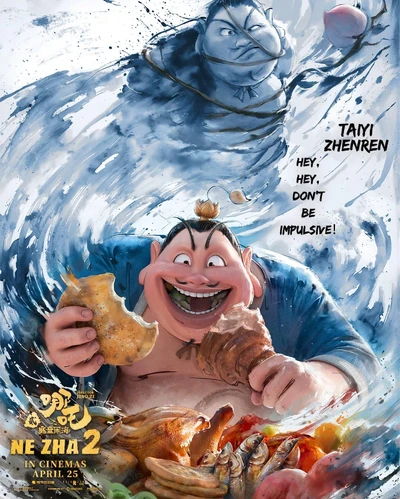
Taiyi Zhenren is a Taoist immortal who lives on the sacred mountain of Kunlun and serves Yuanshi Tianzun. He was tasked with overseeing the reincarnation of the Spirit Pearl into Li Jing's third son — a straightforward divine mission that Shen Gongbao's betrayal turned into chaos.
When the Demon Orb was born instead of the Spirit Pearl, Taiyi offered to kill the child immediately. Li Jing and Lady Yin refused, and Taiyi — despite his bluster — agreed to help. He became Ne Zha's teacher, training the boy in combat and spiritual cultivation while trying (not always successfully) to contain his destructive impulses.
Taiyi is the film's primary comic relief — a fat, bumbling immortal whose divine power is inversely proportional to his competence. He loses the Spirit Pearl because he's drunk. He struggles to control his own artifacts. His flying mount is a pig that he has trouble steering. But when the situation becomes truly dire, Taiyi reveals his genuine power and commitment to his student.
In the final battle, he provides crucial support and later, in Ne Zha 2, plays an even larger role in protecting both Ne Zha and Ao Bing's spirit.
Personality
Lazy, gluttonous, and perpetually put-upon, Taiyi is the immortal who'd rather be napping. But his flaws make him endearing rather than useless — he genuinely cares about Ne Zha and rises to the occasion when it matters. Think of him as the Taoist version of a reluctant mentor: powerful, wise when he bothers to be, and mostly just hoping things work out.
Mythological Origins
In the original myths, Taiyi Zhenren is a far more dignified figure — a powerful immortal who resurrects Nezha using lotus roots after the boy's suicide. He's one of the Twelve Golden Immortals under Yuanshi Tianzun. The 2019 film's comedic portrayal was initially controversial among Chinese audiences familiar with the traditional reverence for the character, but the performance won people over.